

AlphaGenome 2 learns from 100 million cells
Google DeepMind released AlphaGenome 2 on the 11th of November 2026, an AI model trained on more than 100 million single cell profiles. It predicts how small changes in DNA affect hundreds of human cell types, DeepMind said.
 Google DeepMind AlphaGenome 2
Google DeepMind released AlphaGenome 2 on the 11th of November 2026, an AI model trained on more than 100 million single cell profiles. It predicts how small changes in DNA affect hundreds of human cell types, DeepMind said.
DNA is the code inside every cell. A variant is a small change in that code, and some variants lead to disease.
Nearly twice as many finds
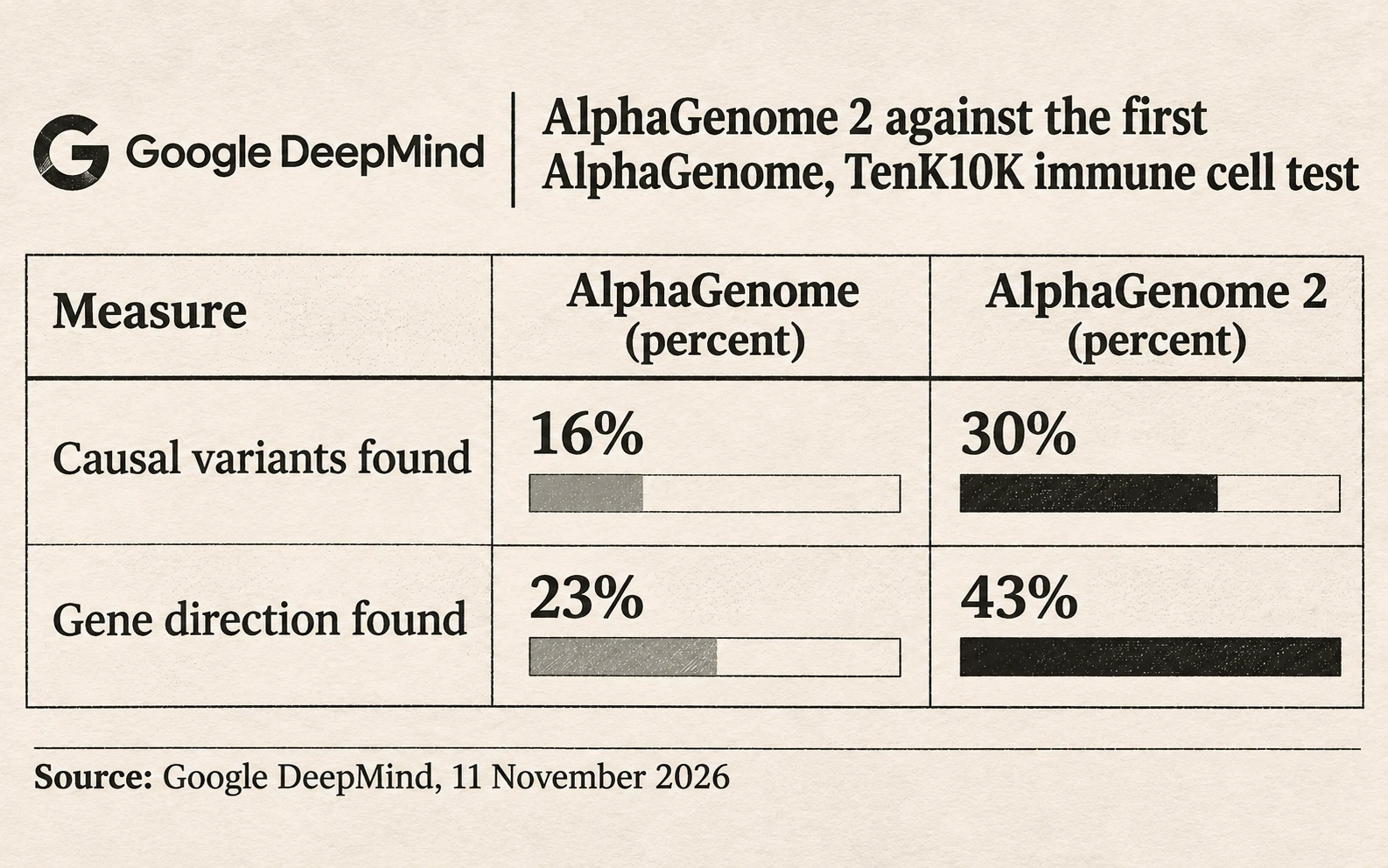
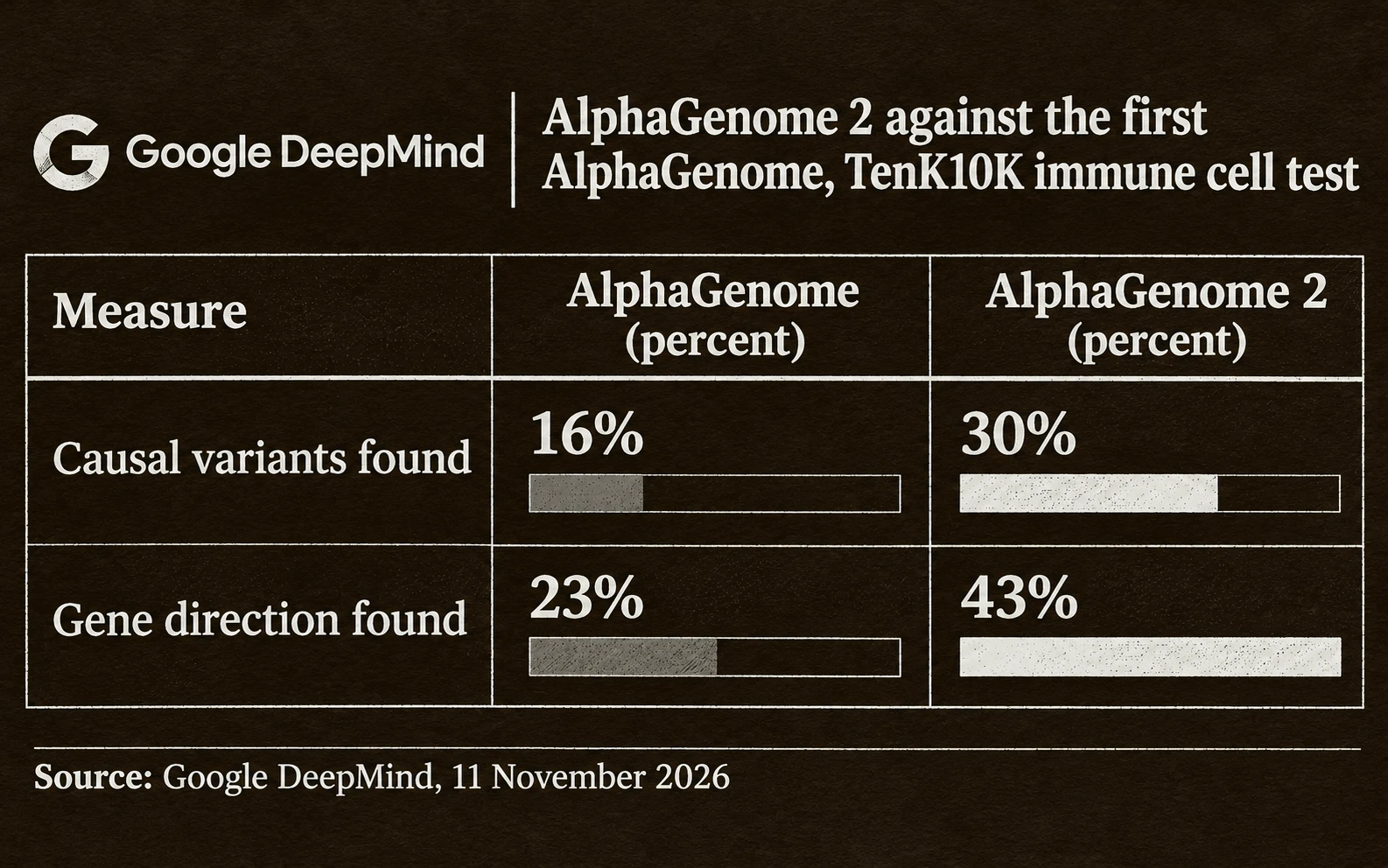
AlphaGenome 2 finds nearly twice as many variants that change gene activity as the first AlphaGenome, DeepMind said. On one immune cell test, it found 30 percent of causal variants against 16 percent.
The training data covered 68 tissues, DeepMind said. The first model looked at broad tissue averages, while the new one looks at single cell types.
New cells without retraining
Scientists can upload data from a few dozen cells, and the model adapts without new training, DeepMind said. In one test, it told vaccine activated immune cells apart from resting ones.
Who can use it
AlphaGenome 2 is open for non commercial research through the AlphaGenome API, DeepMind said. An API is a way for software to use a service, and companies get a private preview.
The model is for research only and is not approved for diagnosis, DeepMind said.
Below we break down the gains
On the immune cell test, 30 percent against 16 percent is about 1.9 times as many finds, by our arithmetic. For gene direction, 43 percent against 23 percent is also about 1.9 times.
What is confirmed and what is not
All results come from DeepMind's own tests. DeepMind gives over 107 million cell profiles when mouse data is counted too.
Key facts
DeepMind released AlphaGenome 2 on the 11th of November 2026.
It learned from more than 100 million cell profiles in 68 tissues.
It is open for non commercial research.
It is not approved for diagnosis.
Source: Google DeepMind blog