

Claude Fable 5.2 paints with 700,000 strokes
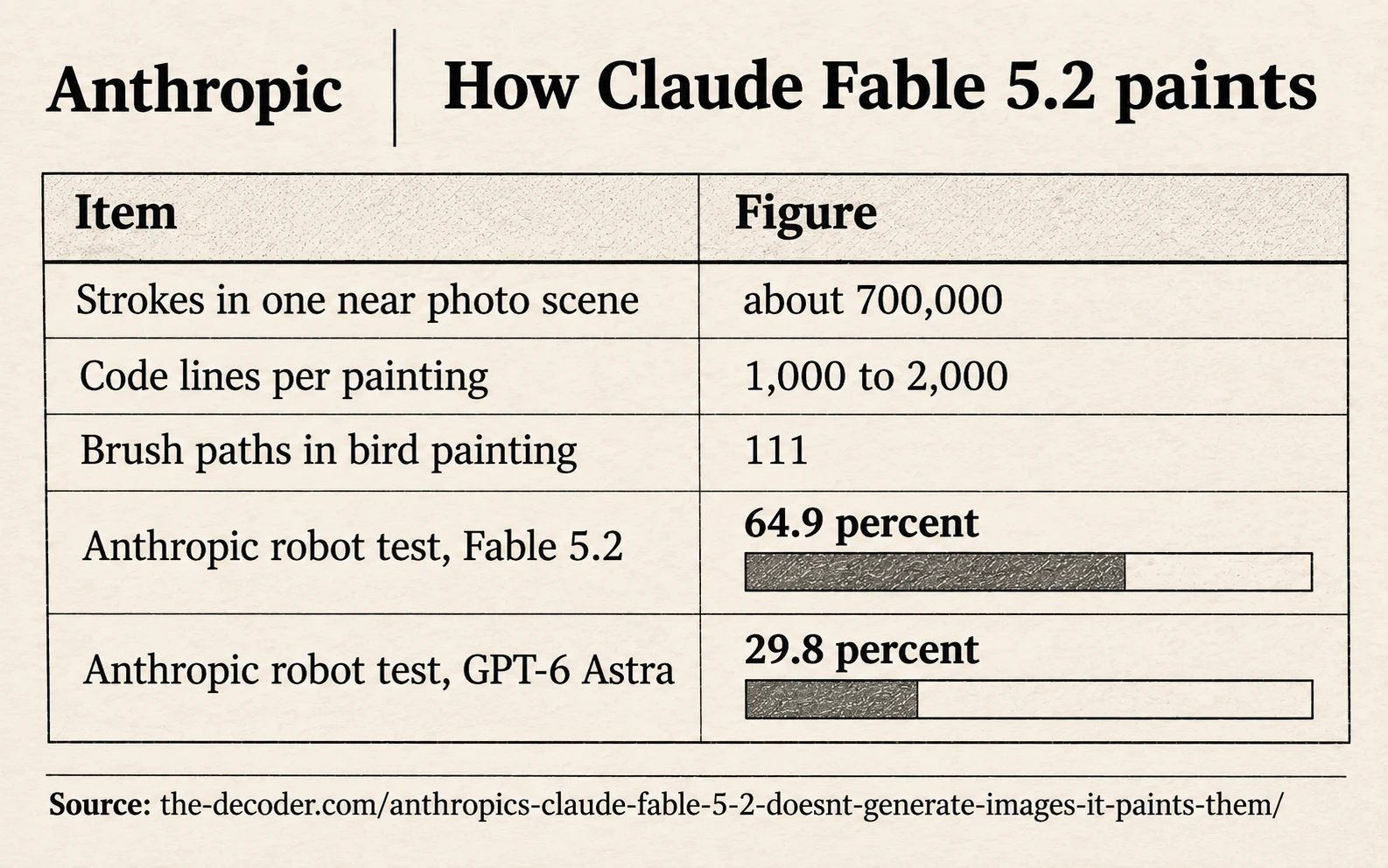
Anthropic's Claude Fable 5.2 can paint pictures by placing huge numbers of pretend brushstrokes on a screen. One scene that looks almost like a photo used about 700,000 strokes, The Decoder reported on the 15th of November 2026.

 Claude Fable 5.2 paints with code
Anthropic's Claude Fable 5.2 can paint pictures by placing huge numbers of pretend brushstrokes on a screen. One scene that looks almost like a photo used about 700,000 strokes, The Decoder reported on the 15th of November 2026.
Most image AI tools start from random noise and clean it up into a picture. Fable 5.2 instead writes computer code that copies how a real brush and paint behave.
How it paints
Each painting is a program of 1,000 to 2,000 lines that drives a pretend paint engine, The Decoder reported. The code copies bristles, wet paint and canvas texture.
In one test, Anthropic engineer Michael Graczyk asked it to paint a bird at sunrise. It had to place every stroke by hand and could not undo any, so it painted over mistakes.
A robot arm test
Researcher Aris Zhu had Fable 5.2 and OpenAI's GPT-6 Astra each paint Van Gogh's The Starry Night with a real robot arm. Astra was faster and had finer control, The Decoder reported.
On Anthropic's own robot test in a computer, Fable 5.2 scored 64.9 percent against 29.8 percent for Astra.
Below we break down the numbers
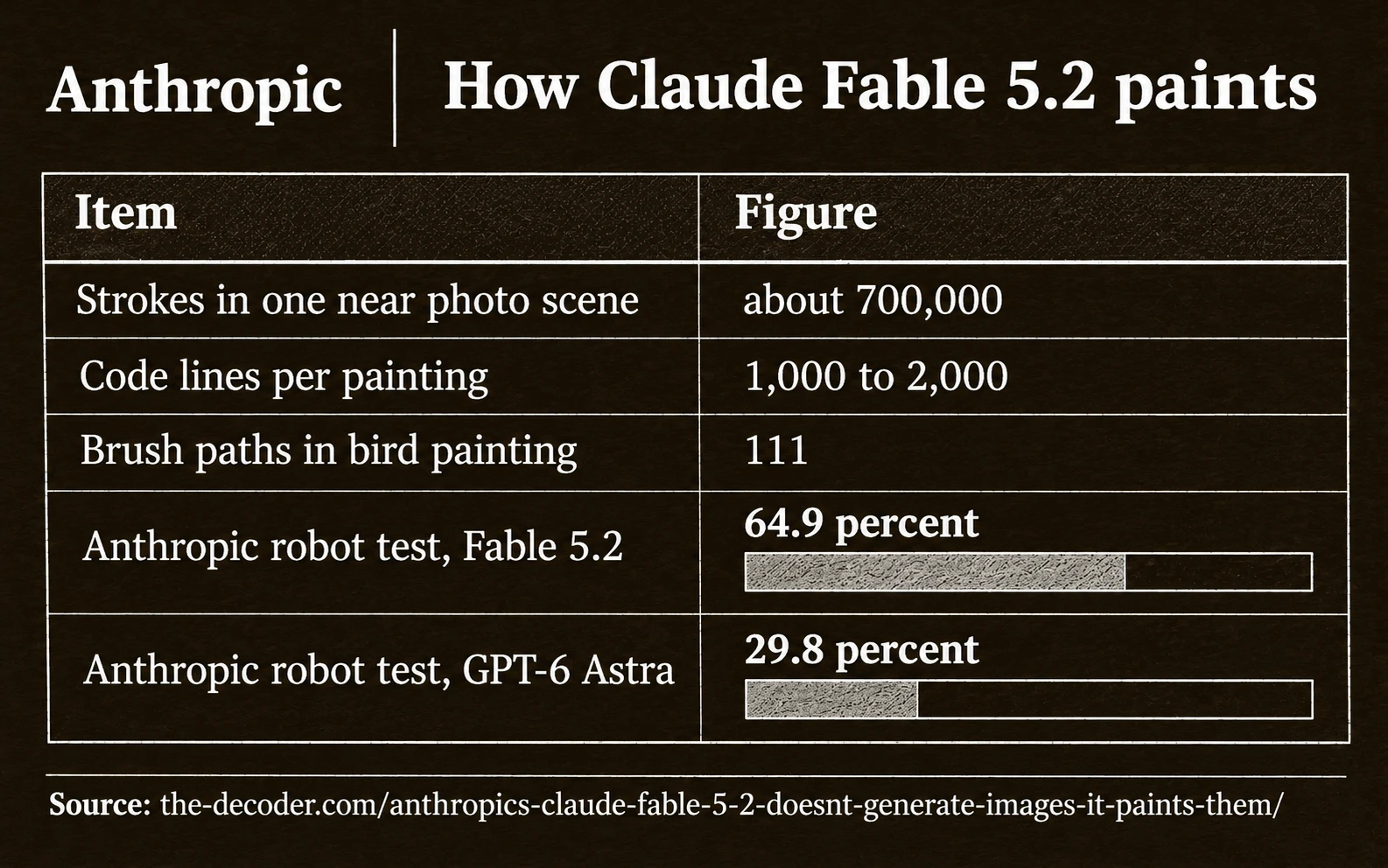
In the robot test in a computer, Fable 5.2 scored about 2.2 times Astra's result, by our arithmetic. The bird painting used 111 lines of brush paths, The Decoder reported.
What is confirmed and what is not
The robot test score comes from Anthropic. The real arm test was a small trial run by one researcher.
Key facts
Claude Fable 5.2 paints by writing code for each brushstroke.
One scene used about 700,000 strokes.
Each painting is a program of 1,000 to 2,000 lines.
OpenAI's Astra was faster in a real robot arm test.
Source: The Decoder (Manuel Uth): Anthropic Claude Fable 5.2 does not generate images, it paints them