

Claude flags 78% of harmful chats on its own
Anthropic's Claude now writes a hidden safety note after each answer, Anthropic said. On Claude Fable 5 the note flags 78% of possibly harmful chats and 94% of the most serious ones.

 Anthropic's Claude safety check
Anthropic's Claude checks each of its own chats for misuse right after it answers, Anthropic said. Its research post is dated the 16th of October 2026.
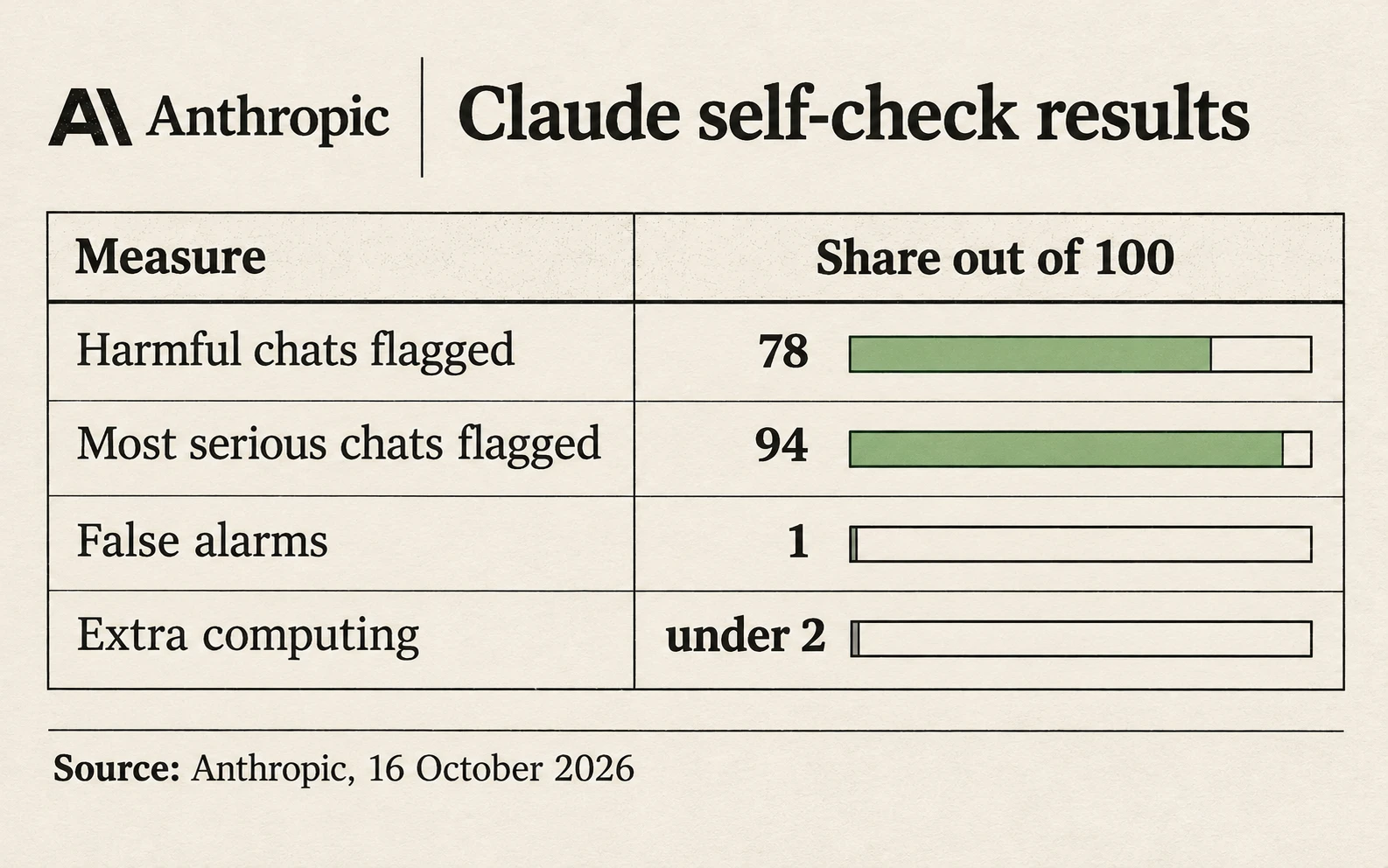
On the Claude Fable 5 model, the check flags 78% of chats that a stronger checker marks as possibly harmful, Anthropic said. For the most serious cases it flags 94%.
How the check works
After each answer, a short hidden instruction asks Claude to think about the safety of the chat. Claude then writes a brief safety note.
The note says whether the chat may be harmful and what kind of harm it is, Anthropic said. It also says how urgently a person should look at it.
Running since June
Anthropic has used the check in every Claude model released since Fable 5 came out in June. It covers a large share of Claude's traffic worldwide, the company said.
The check does not block chats. Flags go to later review, while other tools block harmful requests as they happen, Anthropic said.
What it has found
In September, the flags exposed a romance scam built with Claude Code that targeted dozens of people, Anthropic said. It banned the accounts after a human review.
Limits
Anthropic said the check does not catch every harmful chat. It is also too weak to stop a determined attacker.
Below we break down the cost
Each check adds about 10 extra tokens, the small pieces of text an AI reads and writes, Anthropic said. That adds less than 2% to Claude's computing.
The check wrongly flags 1% of harmless chats, Anthropic said. That is about 1 in every 100, by our arithmetic.
Key facts
Claude writes a hidden safety note after each answer.
On Claude Fable 5 it flags 78% of possibly harmful chats.
It flags 94% of the most serious cases.
The check adds less than 2% to Claude's computing.
It does not block chats and cannot stop a determined attacker.
Source: Anthropic Safeguards