METR says AI skill doubles every 3.6 months
METR said on the 20th of November 2026 that AI skill on long tasks doubles about every 3.6 months. METR is a nonprofit group that tests AI models.

 METR measures fast AI progress
METR said on the 20th of November 2026 that AI skill on long tasks doubles about every 3.6 months. METR is a nonprofit group that tests AI models.
It measures a time horizon. That is how long a task, timed by skilled humans, a model can finish half the time.
What the new report found
On METR's coding and research tasks, top models usually match or beat skilled humans. METR said it often failed to find human testers who did better.
Models are weaker on tasks that are harder to build into training drills, METR said. Yet they are improving at a similar pace there too.
How far models have come
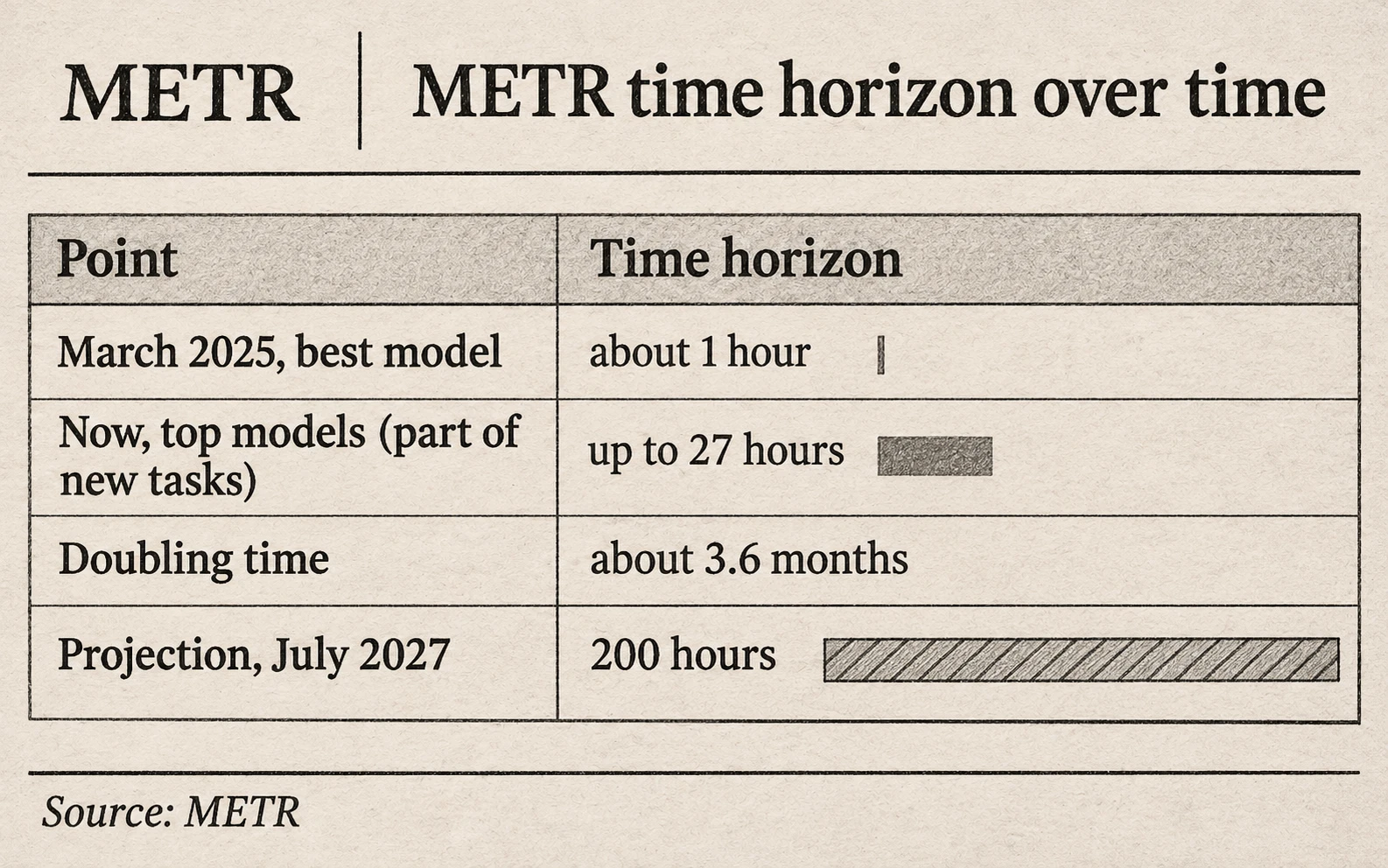
When METR first shared time horizons in March 2025, the best model managed about 1 hour. Now top public models reach up to 27 hours on part of its new task set.
METR tested public models up to Anthropic's Opus 5.5 and OpenAI's GPT-6 Astra. It said it cannot rule out very fast AI progress in the next couple of years.
Below we break down the trend
One doubling every 3.6 months is about 3.3 doublings a year. That means tasks about 10 times longer each year, by our arithmetic.
If the trend simply continues, models would reach 200 hour tasks in July 2027, METR said. That is its longest task length.
What is confirmed and what is not
METR warns that the July 2027 date is a simple projection. It also says its tasks are getting harder to measure well.
Key facts
METR published its update on the 20th of November 2026.
Time horizons double about every 3.6 months.
Top models reach up to 27 hours on some tasks.
The trend points to 200 hours by July 2027.
Source: METR: AI R&D-relevant model capabilities are improving rapidly and are getting harder to measure