

OpenAI AI helps on a 50 year physics puzzle
OpenAI started a science blog on the 15th of November 2026. Its first guest post says its GPT-6 Astra model helped a physicist with a problem open for over 50 years.
 OpenAI starts a science blog
OpenAI started a science blog on the 15th of November 2026. Its first guest post says its GPT-6 Astra model helped a physicist with a problem open for over 50 years.
The physicist is Nathaniel Craig, who leads the particle theory group at the University of California, Santa Barbara. He is also a visiting scientist at OpenAI.
The problem
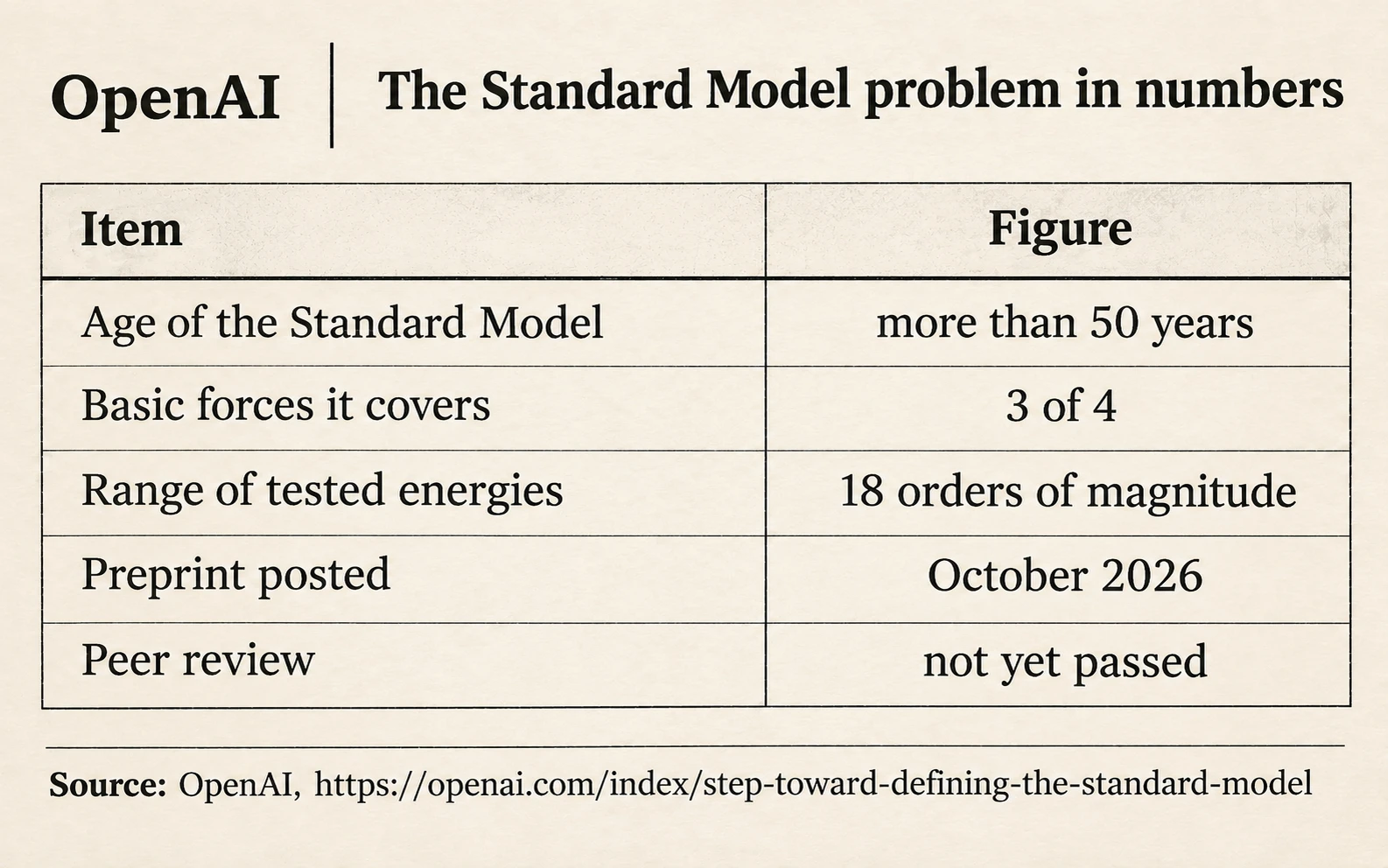
The Standard Model is the main theory of the smallest particles and three of the four basic forces of nature. It matches experiments very well, but it lacks a full math definition.
Physicists usually solve it with small step by step fixes. That method fails for some things, such as where most of a proton's mass comes from.
What the AI did
Craig proposed a way to define the theory on a lattice, a grid that stands in for space and time. He said he had a plan but could not prove it worked in every case.
Astra helped turn that plan into a full build and took the lead on the detailed proof, Craig wrote. The work is in a preprint, a paper posted before outside review, from October.
The new blog
OpenAI said the blog will share findings, working methods and first hand stories from scientists using AI. It said posts will also cover where a method falls short.
Below we break down the scale
Craig wrote that the Standard Model's predictions match experiments across 18 orders of magnitude in energy. That is a range of a billion billion times, by our arithmetic.
What is confirmed and what is not
The preprint has not yet passed peer review, the check by other experts.
Key facts
OpenAI launched a science blog on the 15th of November 2026.
Physicist Nathaniel Craig used GPT-6 Astra on a Standard Model proof.
He wrote that Astra led the detailed proof.
The work is in a preprint from October.
Source: OpenAI: A step toward defining the Standard Model on a lattice