OpenAI drug test has 99 chemistry problems
OpenAI released MedChemBench on the 20th of November 2026, a drug test with 99 chemistry problems for AI models. It checks how well models reason about possible new medicines.
 OpenAI launches MedChemBench test
OpenAI released MedChemBench on the 20th of November 2026, a drug test with 99 chemistry problems for AI models. It checks how well models reason about possible new medicines.
The problems come from 117 published papers and patents, OpenAI said. They include 761 different molecule structures.
What the test checks
The test grades four skills, OpenAI said. Models must rebuild molecules from drawings, explain lab results, rank compounds and predict their properties.
Drug makers face hard tradeoffs, OpenAI noted. A compound might fight a disease well but break down too fast in the body.
How the models scored
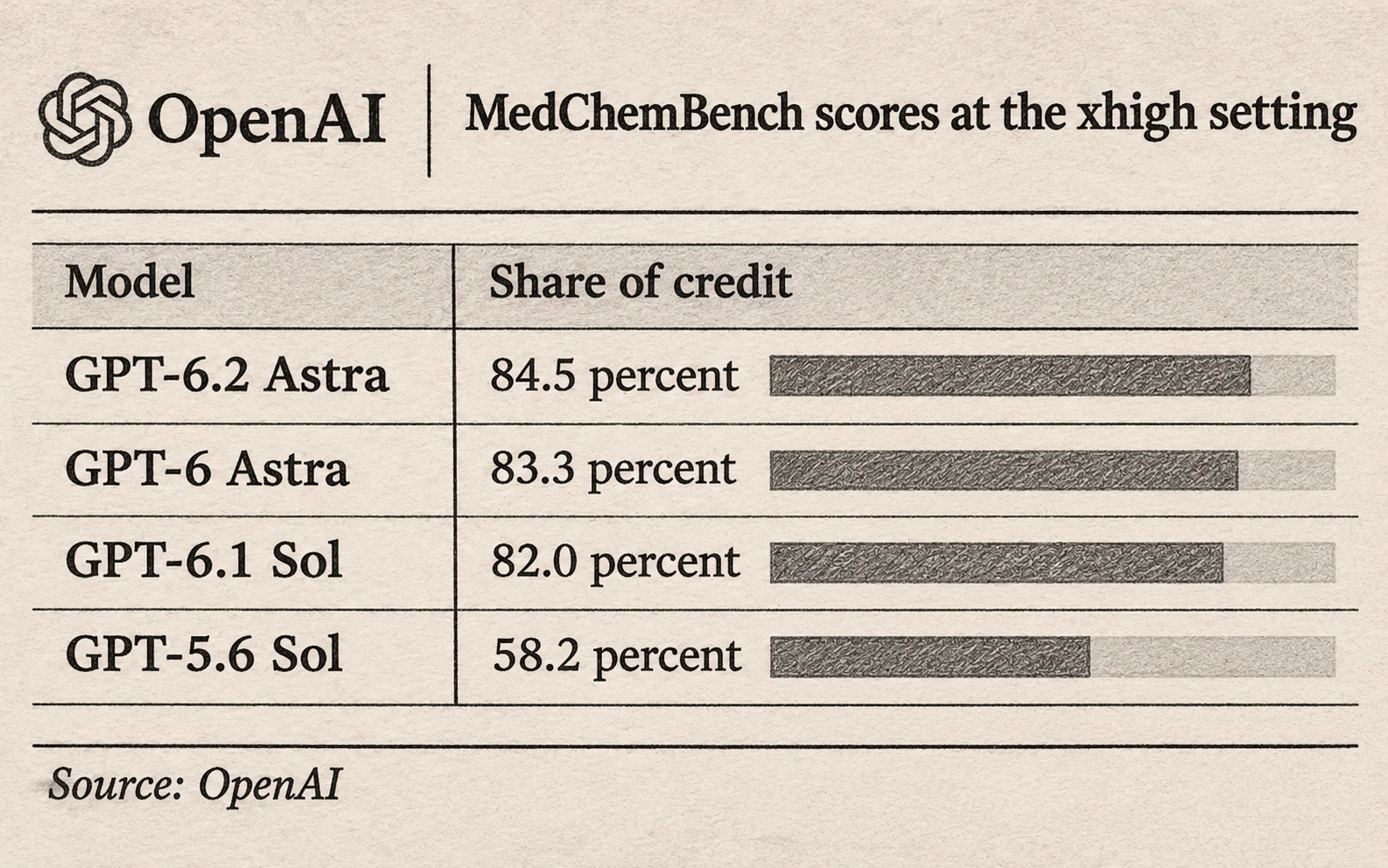
GPT-6.2 Astra earned 84.5 percent of the possible credit at its highest standard setting, OpenAI said. GPT-6 Astra scored 83.3 percent and GPT-6.1 Sol 82.0 percent.
The older GPT-5.6 Sol scored 58.2 percent. OpenAI tested eleven of its own models in total.
Below we break down the weak spots
Astra earned 95.4 percent of the credit for rebuilding molecules, OpenAI said. Yet it got only about half the credit for picking compounds and predicting numbers.
That means two of the four skills sit near 50 percent. The gap from GPT-5.6 Sol to GPT-6.2 Astra is 26.3 points, by our arithmetic.
What is confirmed and what is not
OpenAI says the results do not show that models can discover new drugs. The models may have seen the source papers in training.
Each answer was one try with no tools, OpenAI said. Only OpenAI models were tested.
Key facts
OpenAI released MedChemBench on the 20th of November 2026.
The test has 99 problems from 117 papers and patents.
GPT-6.2 Astra scored 84.5 percent.
Models scored about half on picking compounds.
Source: OpenAI: Can AI help scientists identify promising drug candidates?