

OpenAI's unreleased AI writes 722 math papers
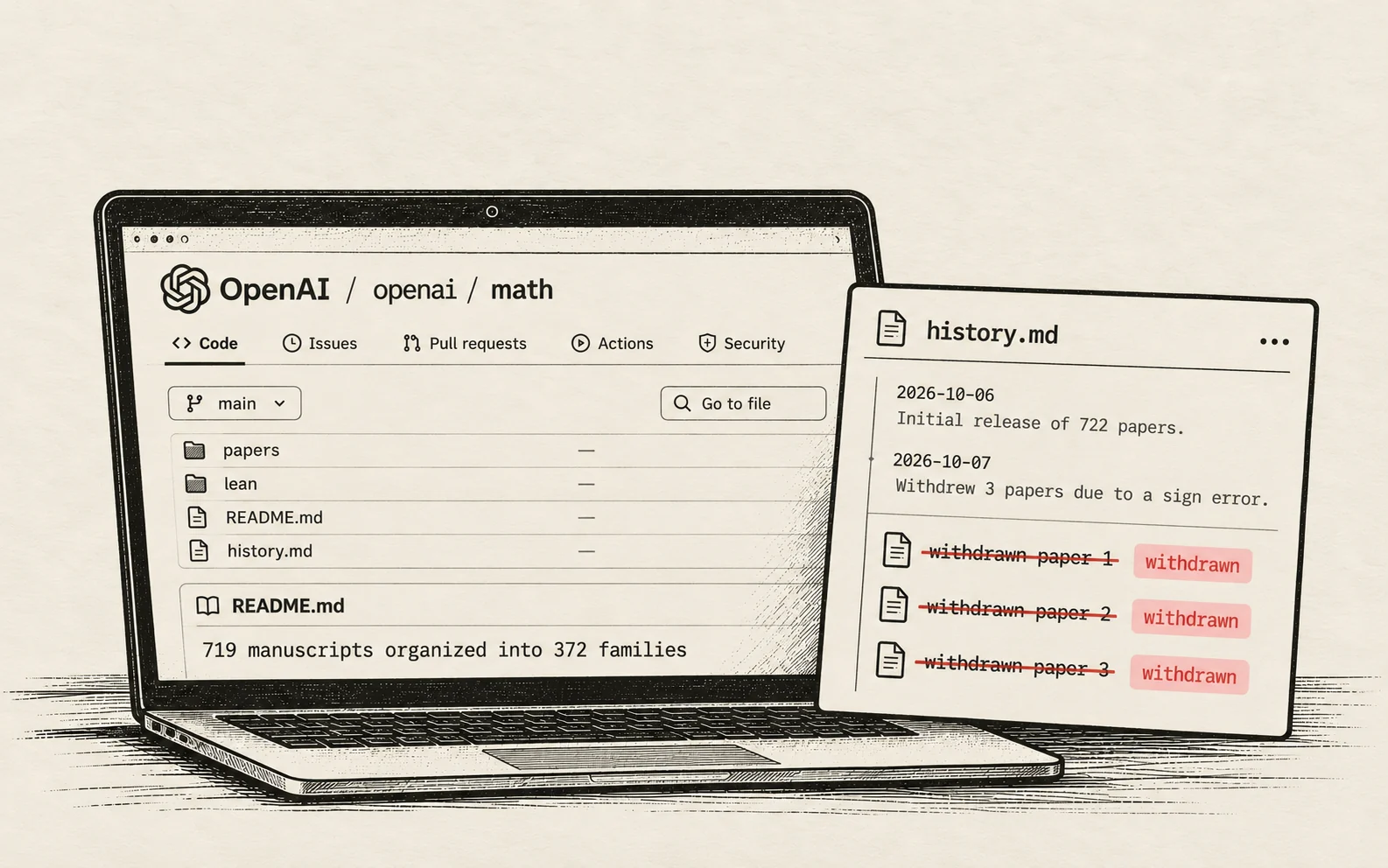
OpenAI posted 722 math papers from an unreleased model on GitHub on the 6th of October and withdrew 3 in a change log dated the 7th. About 42 in every 100 main results come with a proof a computer has checked, the company says.
 OpenAI's math release on GitHub
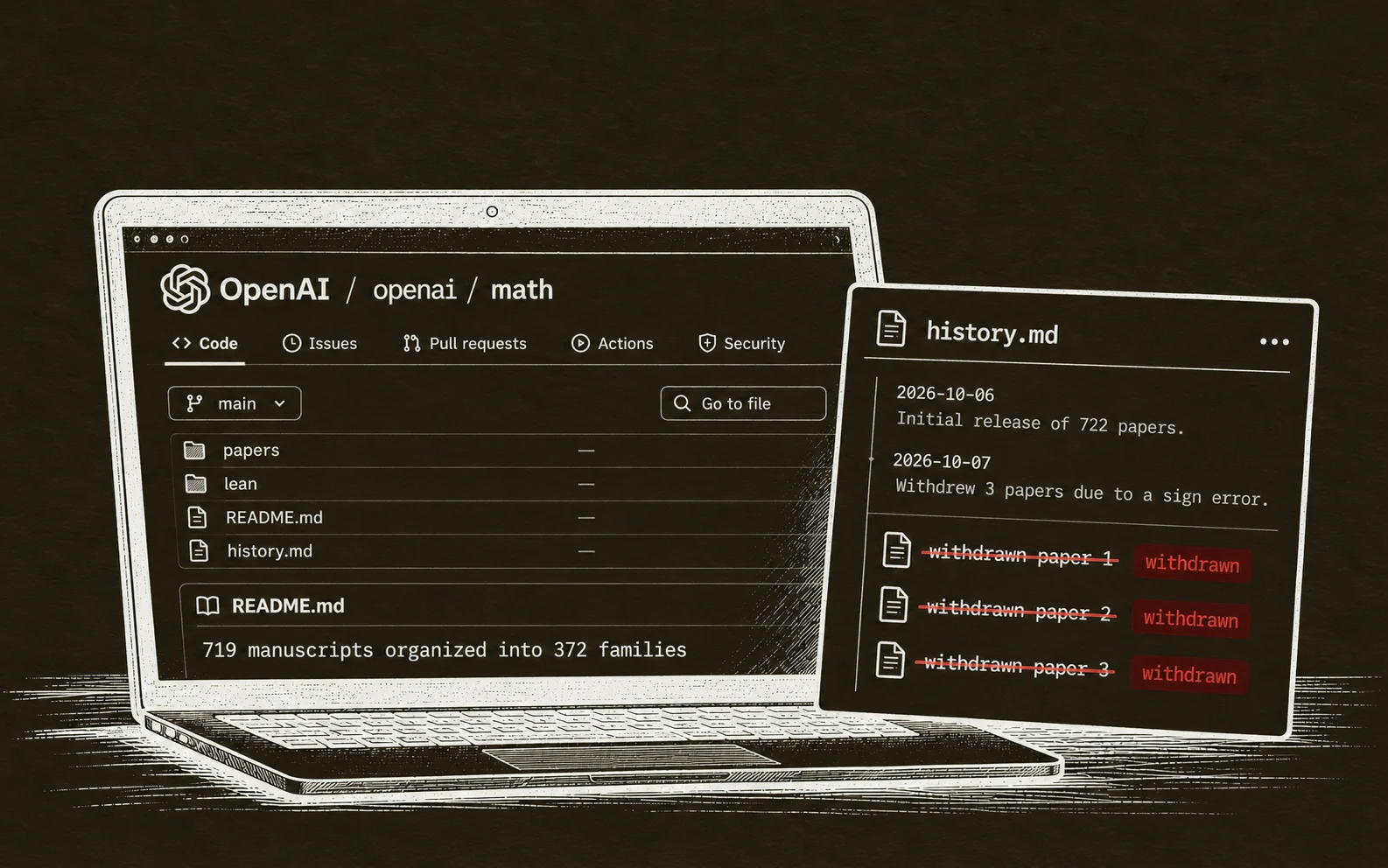
OpenAI posted 722 math papers on GitHub on the 6th of October 2026, its blog post said. The post says an unreleased model wrote them.
A change log dated the 7th withdrew 3 over a sign error and revised 14. About 42% of main results have a computer-checked proof, OpenAI says.
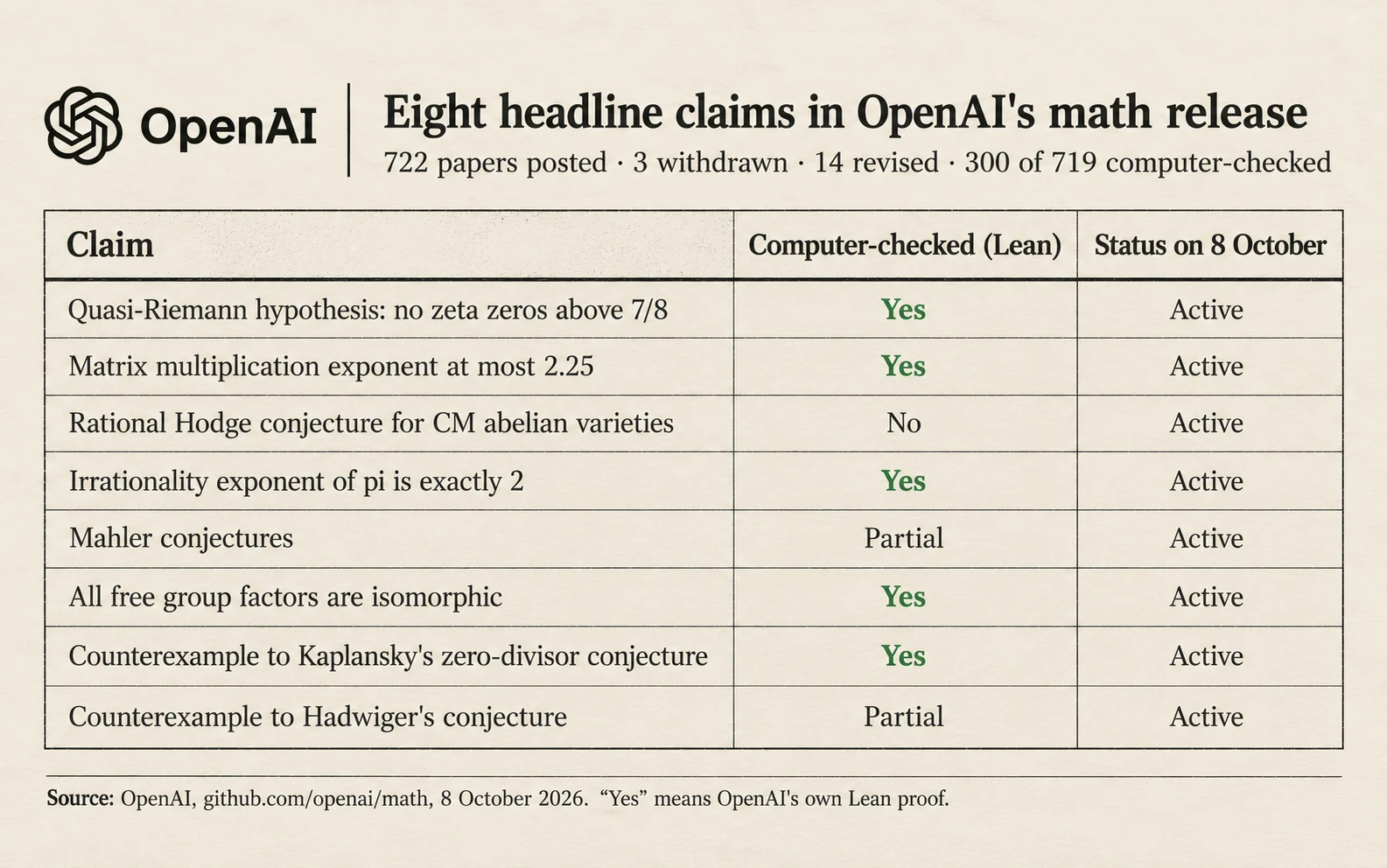
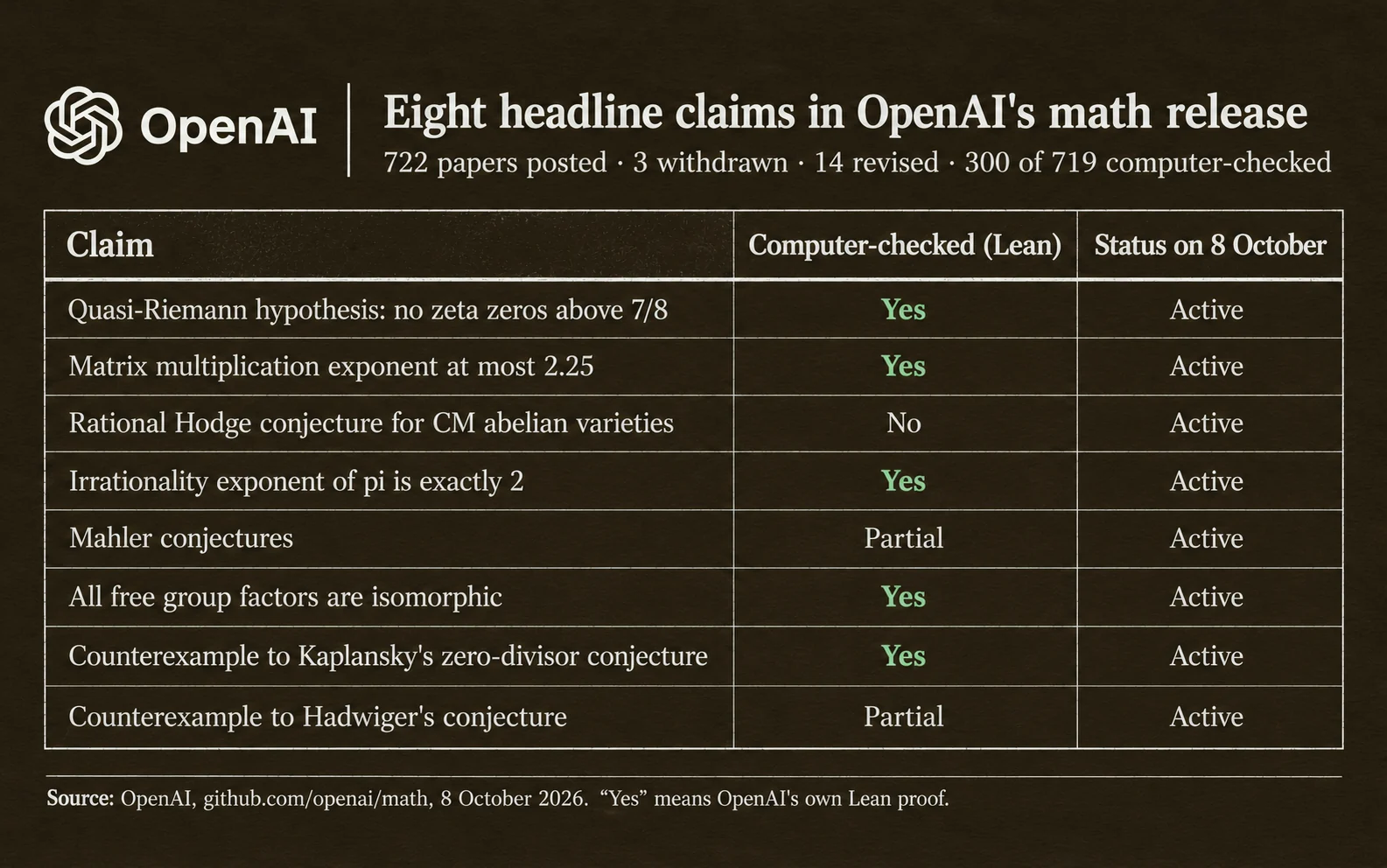
Below we break down the 722 papers: 3 withdrawn, 14 revised, 42% checked by computer
The papers form 372 result families, OpenAI's README says.
The withdrawals leave 719. The log updated 13 more for citations only, so 30 changed, about 4%, by our arithmetic.
A computer-checked proof is written as code, so a program can test every step. OpenAI writes them in Lean, its blog says.
OpenAI counts 300 of 719 as checked, about 42%.
The headline claims: the quasi-Riemann hypothesis and a matrix bound of 2.25
First is the quasi-Riemann hypothesis, a weaker form of Riemann's 1859 problem. A paper with a Lean proof says zeta has no zeros where the real part tops 7/8.
A second paper says the matrix multiplication exponent is 2.25 or less for complex numbers. A lower exponent means big grids of numbers multiply faster, in theory.
The previous record, 2.371177, came in a paper of the 17th of August made with Google DeepMind's AlphaEvolve.
Douglas, Martin and McMullen react: "a new era" and "a messy first draft"
Harvard's Michael Douglas said in Scientific American on the 8th that "a new era of math" began. Ursula Martin of Oxford, quoted by Nature on the 7th, said OpenAI was "tossing the community a messy first draft."
In CNET on the 9th, Curtis McMullen of Harvard said AI companies' rollout showed "disregard for the profound disruption to our community." Researchers told The Verge that day that grasping the release "could take years."
What is still open: who found the error, and what Lean checks
On the 8th, Retraction Watch reported a spokesperson said OpenAI found the errors in an audit. Scientific American wrote the same day that outside scientists found mistakes.
The computer checks only the Lean version. An arXiv paper of the 6th argued that the Lean form of OpenAI's September Navier-Stokes proof does not match its text.
Key facts
OpenAI posted 722 math papers on GitHub on the 6th of October 2026.
3 were withdrawn and 14 revised, leaving 719.
About 42% of main results have a Lean proof, OpenAI says.
Source: OpenAI blog post "Sharing AI progress in mathematics" and the openai/math GitHub repository