

OpenAI says its AI solved 3 open problems
OpenAI said on the 26th of October 2026 that its in-house AI models produced 3 new results in maths, computer science and physics. Outside experts have yet to review them.
 OpenAI's AI takes on 3 old problems
OpenAI said on the 26th of October 2026 that its in-house AI models produced 3 new results in maths, computer science and physics. None of the 3 has been through a formal check by outside scientists yet.
OpenAI asked leading experts to lead groups that will study the results. It said it seeks no academic credit for the work.
The maths result
The maths result is a proof of the local smoothing conjecture, a 1991 question about how waves focus. OpenAI said the proof also settles the related Kakeya and restriction conjectures.
OpenAI posted the proof and a version in Lean, a program that checks each step of a proof by computer.
The computer science result
OpenAI said its AI proved the Exponential Time Hypothesis false. The hypothesis is a widely used guess about how hard some computer problems are, and hundreds of papers rely on it.
A group led by Russell Impagliazzo, Ramamohan Paturi and Ryan Williams will check it. Impagliazzo and Paturi first proposed the hypothesis.
The physics result
The third result is a proof that key physics theories hold up in strict maths terms. They include the theory of the strong force, which holds the cores of atoms together.
Nobel prize winner David Gross will lead that group, OpenAI said. The group chose to hold back the AI's files for now.
Below we break down the timeline
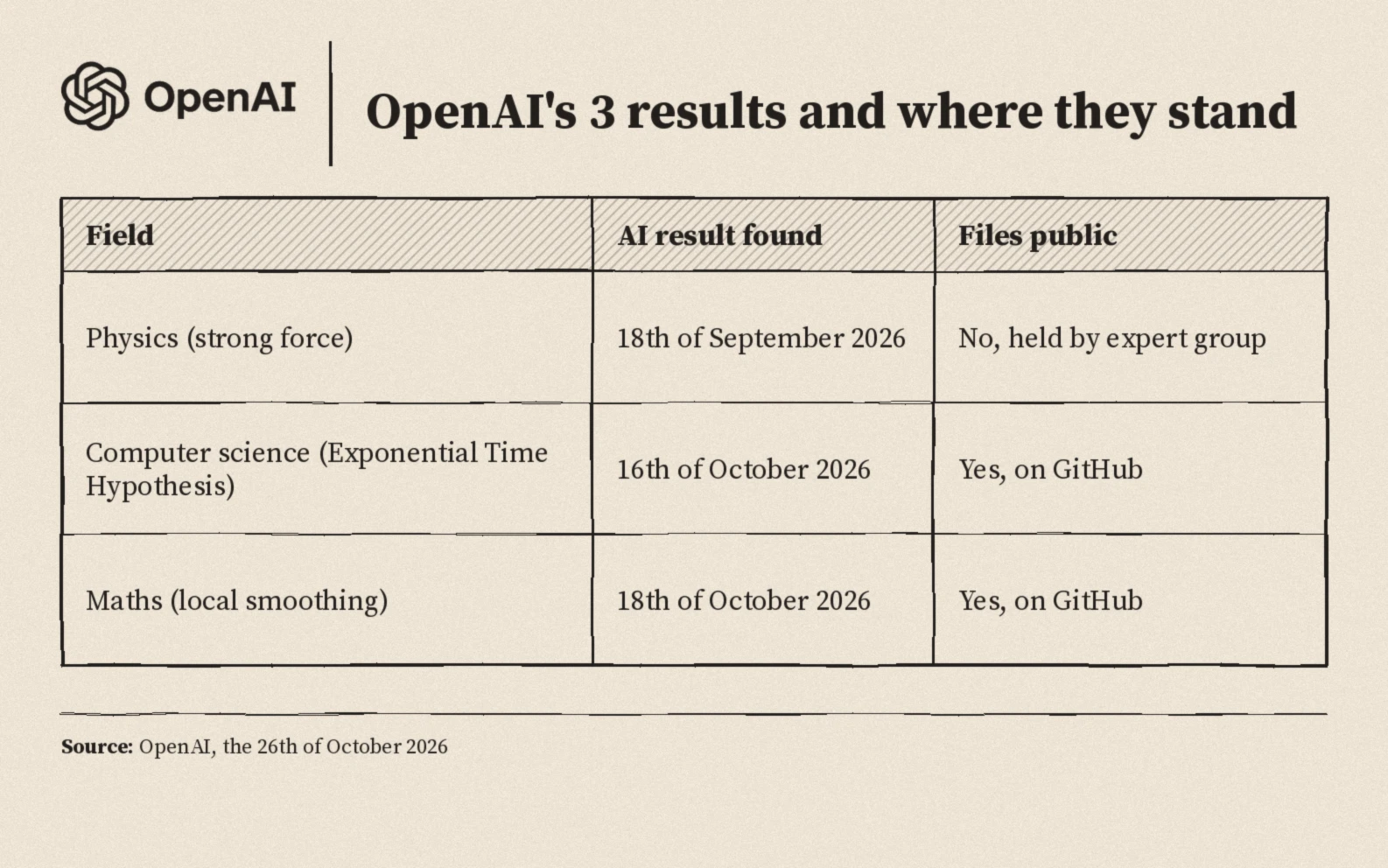
The physics proof came out about 5 weeks after the AI found it, by our arithmetic. The maths proof came out after 8 days.
What is confirmed and what is not
OpenAI says a computer checked the maths and computer science proofs in Lean. No outside group has published its own review yet.
Key facts
OpenAI announced 3 results on the 26th of October 2026.
The maths and computer science proofs are public on GitHub.
The physics files are held back by its expert group.
OpenAI seeks no academic credit.
Source: OpenAI, Working with academic communities, the 26th of October 2026