

Unitree G1 climbs ladders after 13 minutes
Researchers led by ETH Zurich taught a Unitree G1 humanoid robot to climb ladders. Training used 13.2 minutes of recorded human movement, then days of practice in a computer simulation.

 A robot learns to climb ladders
A Unitree G1 humanoid robot learned to climb ladders with help from 13 minutes of recorded human movement, ETH Zurich researchers wrote. A video of the robot spread on X on the 23rd of October 2026.
The 13.2 minutes is human motion data used in training. The robot then practised for days in a computer simulation, learning by trial and error.
How it works
The recordings show where hands, feet, knees, elbows and hips should touch the world. A planner on the robot picks the next touch point for 9 body parts, up to 1.5 seconds ahead.
A second program then moves 23 joints, 50 times a second. Both run on the robot's own small computer, using a laser scanner to see.
The paper shows the robot on ladders, stairs and boxes. It can also vault and get up after a fall.
Who made it
The authors come from ETH Zurich, the National University of Singapore, Apple and Nvidia. They include robot expert Marco Hutter of ETH and Vladlen Koltun of Apple.
Below we break down the numbers
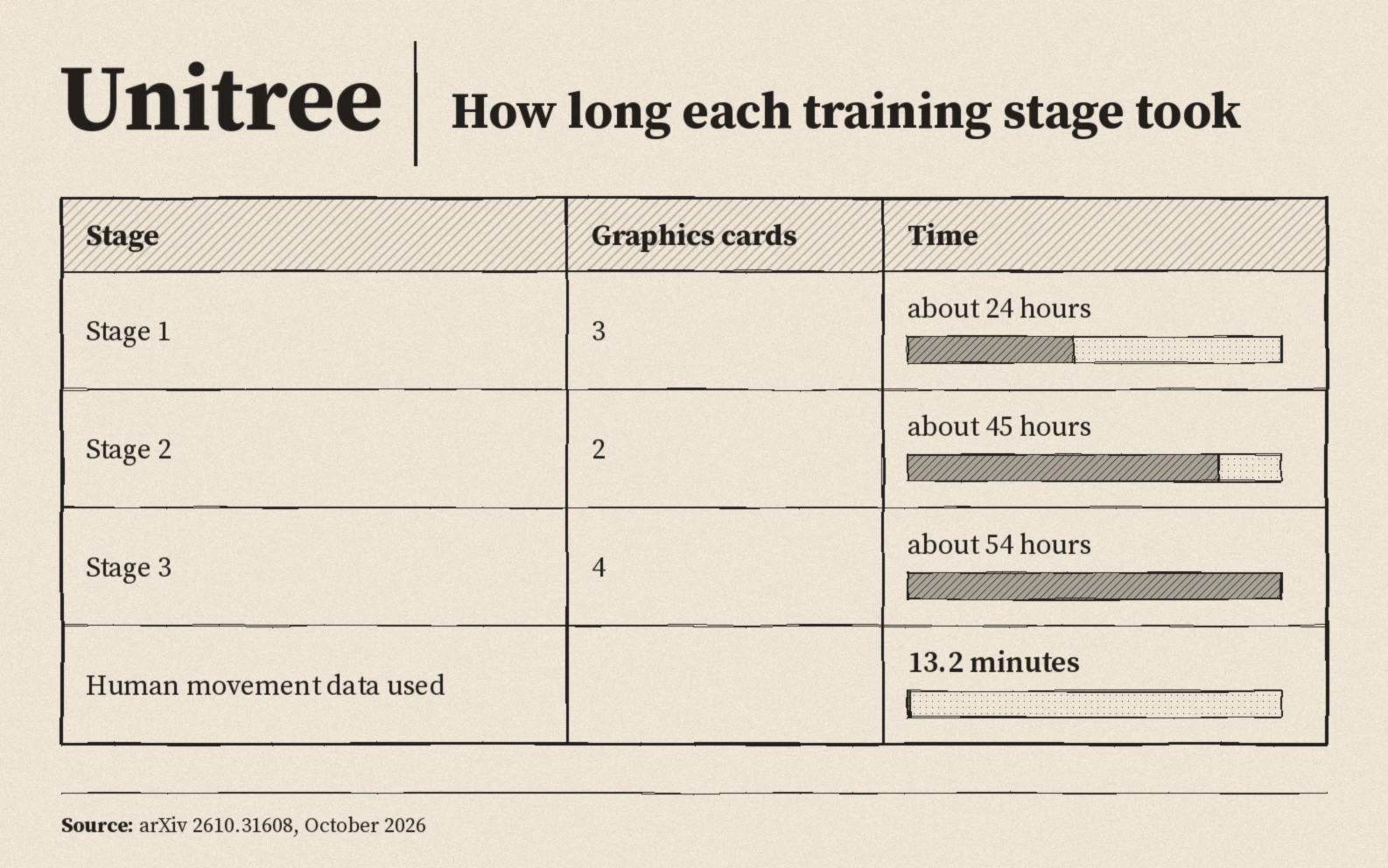
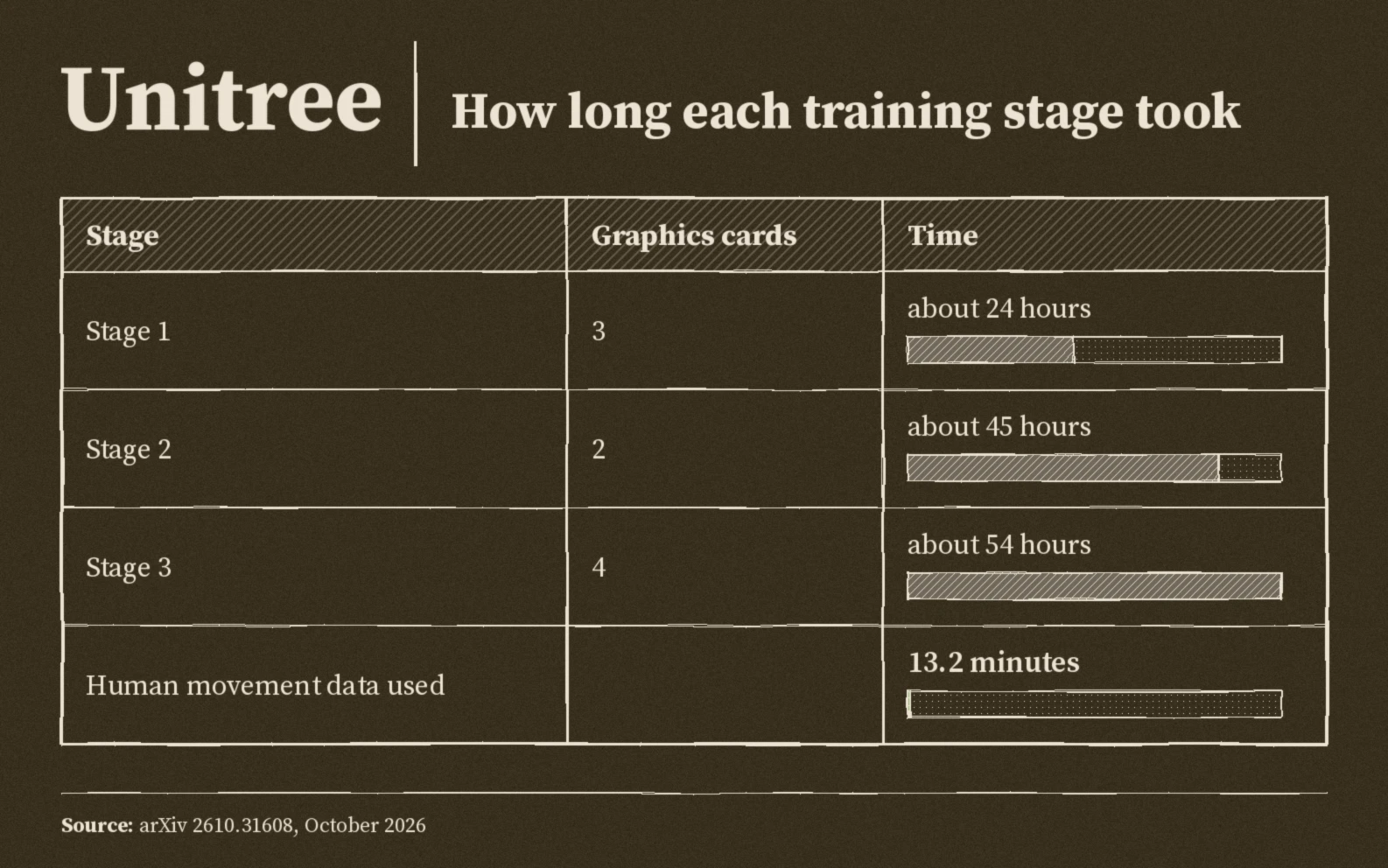
Training took about 123 hours, or just over 5 days, across 3 stages, by our arithmetic. That is about 560 times longer than the human data.
On mixed obstacle courses the robot succeeded 92.5 percent of the time. MGMT, the closest older method, reached 58.8 percent.
What is confirmed and what is not
All results come from the authors' own tests. No outside group has repeated them yet.
Key facts
The robot is a Unitree G1 humanoid.
It trained on 13.2 minutes of recorded human movement.
It plans touch points for 9 body parts.
All its software runs on the robot itself.
Source: arXiv, Humanoid Mobility via Attention-based Contacts, 2610.31608