

Vitamin C cuts flow battery cost 20 percent
An AI agent at the Shanghai Artificial Intelligence Laboratory picked vitamin C as a way to improve large batteries, the lab told Jiefang Daily. The paper's report ran on People's Daily online on the 23rd of November 2026.

 Shanghai AI Lab finds a battery helper
An AI agent at the Shanghai Artificial Intelligence Laboratory picked vitamin C as a way to improve large batteries, the lab told Jiefang Daily. The paper's report ran on People's Daily online on the 23rd of November 2026.
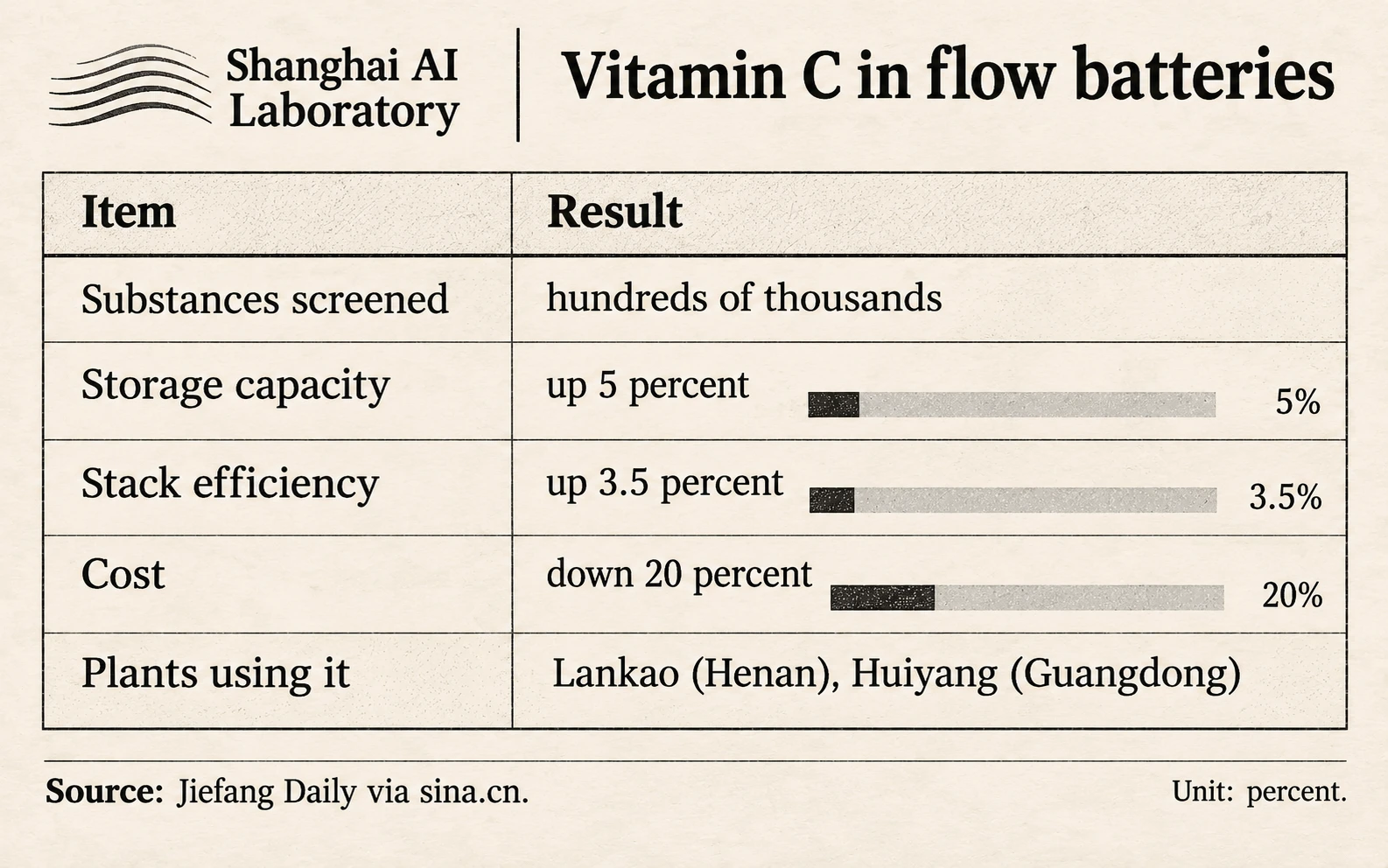
The new mix is now used at energy storage plants in China. There, it raised capacity by 5 percent and cut costs by 20 percent, the report said.
What the AI did
The agent, called Shusheng Nenggong, searched hundreds of thousands of substances. It ranked vitamin C first as an additive for iron and chromium flow batteries.
A flow battery stores power in tanks of liquid. It can hold wind and solar power for hours.
Why vitamin C works
Researchers doubted the result, then tested it. Vitamin C keeps key parts of the liquid stable, so the battery works across more temperatures.
"This discovery broke our fixed way of thinking," said Zhou Tianhang of China University of Petroleum in Beijing. He worked with Gu Qinying of the Shanghai lab.
Where it is used
After rounds of AI advice and lab tests, the team made a new liquid recipe. It is used at plants in Lankao in Henan and Huiyang in Guangdong.
The plants gained 5 percent more storage and 3.5 percent better efficiency, the report said.
Below we break down the numbers
A cost cut of 20 percent means a plant part that cost 100 yuan now costs about 80 yuan. A 5 percent capacity gain turns 100 hours of stored power into 105.
What is confirmed and what is not
The gains come from the project team's own review. No outside study of the plant results was found.
Key facts
Shanghai AI Laboratory's agent picked vitamin C as a battery additive.
The mix is used at plants in Henan and Guangdong.
Costs fell by 20 percent, the report said.
Storage rose by 5 percent.